Weighing Up the Refill Aisle: What UK Supermarket Dispensers Really Save You
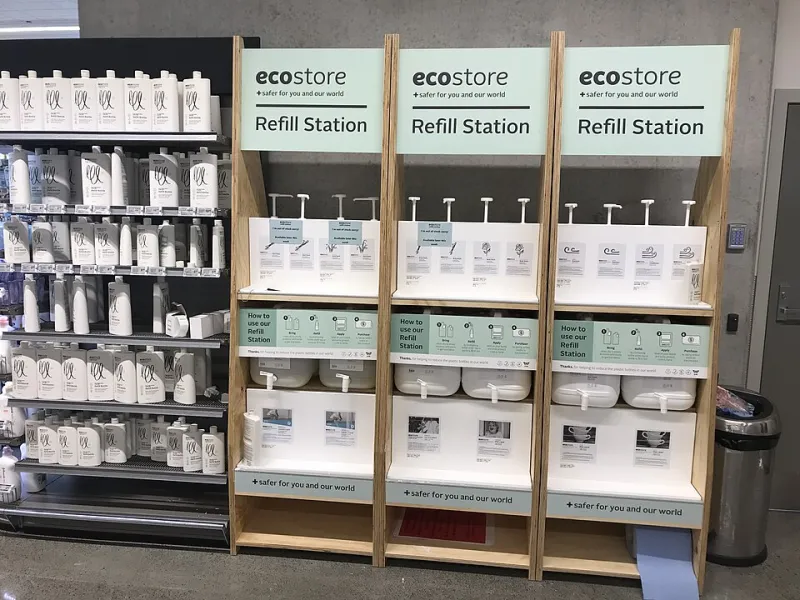
Photo: Schwede66, CC BY-SA 4.0, via Wikimedia Commons
Refill stations have moved from niche health-food shops to the middle of the weekly supermarket run. In 2026 you can fill a jar with oats in one aisle, top up laundry liquid in another, and still pick up a bag of frozen peas on the way out. That sounds like progress — and often it is. But the refill aisle is not automatically cheaper or more convenient than buying a packet. Some stations are genuinely worth the detour; others are a nice bit of theatre that adds a few pounds to your basket and a small dent to your plastic bin. Here is how to tell the difference without spending your whole Saturday comparing dispensers.
The lay of the land in 2026
Most large UK supermarkets now have some form of unpackaged or refill offering, though the scale varies wildly. Some have a bank of dry-goods hoppers for pasta, rice, oats, nuts and dried fruit. Others stick to a laundry-liquid tap or a water refill point. A few have trialled bring-your-own-container schemes for everything from cereals to shampoo, then quietly scaled them back when the footfall did not justify the floor space.
Independent refill shops are a different beast. They tend to have a wider range, better labelling and staff who will talk you through tare weights without sighing. They also tend to be smaller, which means a trip is a deliberate errand rather than a swerve on the way to the checkout.
The honest starting point is this: a refill station is only worth using if it fits your normal shopping rhythm. If you have to drive 20 minutes to a shop that only sells refills, the fuel and time cost can wipe out the plastic saving. If the station is in the supermarket you already visit, the maths is much kinder.
The cost-per-gram reality check
This is where the green glow often fades. Refill does not always mean cheaper. Sometimes you are paying for the convenience of the dispenser, the staff time, the smaller scale and the fact that the product is organic or premium. That can be fine — but it is not a saving.
A useful habit is to compare price per 100g or per litre, not price per pack. Supermarket own-brand pasta in a 500g bag often works out cheaper per gram than the same style of pasta from a refill hopper. The refill wins on packaging, not on pennies. On the other hand, some dry goods — particularly nuts, seeds, dried fruit and herbs — can be competitive, especially if you only need a small amount and would otherwise buy a bigger bag that goes stale.
Laundry liquid is a mixed picture. A refill tap saves the plastic bottle and usually lets you buy exactly the amount you need. But check the dilution instructions. A concentrated refill that costs more per litre may still work out cheaper per wash. A cheap own-brand liquid that is mostly water may look like a bargain on the shelf and then vanish in a fortnight. The only fair comparison is cost per wash, not cost per bottle.
Convenience maths: the time-and-travel tax
Convenience is not just about whether the station is nearby. It is about whether the trip adds friction to your week. A refill station that is open 8am to 8pm and sits beside the milk aisle is easy. A refill shop that is open 10am to 4pm, Tuesday to Saturday, and has a one-in-one-out policy on a Saturday morning is a different commitment.
There is also the container admin. You need to remember jars, bags, bottles, labels and a pen. You need to know the tare weight before you fill. You need a plan for getting the stuff home without it rolling around the boot. None of this is hard, but it is enough to derail a good intention if you are already rushing.
The stations that earn their keep tend to be the ones that reduce friction rather than add it. If you can tare your container at the till, fill it, pay at the checkout and carry on with the rest of your shop, that is a workable routine. If you have to queue at a separate counter, wait for a staff member to unlock a dispenser and then hand-write a label, you need to really want those oats.
Which stations tend to be worth it
There is no universal answer, but some patterns hold. Dry-goods stations are worth a look if you eat a lot of the same staple and can get through it before it goes stale. They are less useful if you are buying a tiny amount of something exotic just to try it, because the price per gram is often high and the plastic saving is small.
Laundry-liquid refills are worth it if the price per wash is close to your usual brand and the station is somewhere you already shop. Water refills are a no-brainer if you are out and about, though they are not really a weekly-shop item.
Independent refill shops are often best for the things supermarkets do badly: herbs and spices in small amounts, shampoo and conditioner refills, dried beans and pulses, and household cleaning liquids. They are also more likely to let you bring any clean container, which saves you buying a branded jar you do not need.
The weakest offerings are usually the ones that sell premium snacks, fancy granola and decorated containers. Those are not refill stations so much as gift shops with a scoop. You can still use them, but do not kid yourself that you are saving money.
The in-store checklist
Before you fill a single jar, run through this:
- Check the price per 100g or per litre against the packaged version. If the shelf does not show it, use your phone calculator.
- Weigh your empty container first and write the tare weight on the lid. Do not rely on memory.
- Look at the dispenser. Is it clean? Is the product fresh-looking? Are the lids closed? A dusty hopper is a red flag.
- Ask how often the stock is turned over. Slow-moving refills can be stale, especially nuts and wholemeal flour.
- Check whether the product is organic, fairtrade or just expensive. Those labels may justify a higher price, but they are not the same as a saving.
- Find out if there is a minimum spend or a charge for containers. Some shops add a fee for compostable bags, which can cancel out the plastic saving.
- See if the station is included in the store's loyalty scheme. Points are not cash, but they add up.
- Ask what happens if you overfill. Some tills will not let you put back the excess, so fill in small batches.
Storing refills without buying more containers
The irony of refill shopping is that it can tempt you into buying a matching set of glass jars, labelled scoops and a chalk pen. You do not need any of that. The best container is one you already own.
Use clean jam jars, sauce jars, takeaway tubs, ice-cream containers, large yoghurt pots and old bread bags. Glass jars are good for pasta, rice, oats and nuts. Plastic tubs are fine for dried fruit and snacks. Old laundry bottles can be rinsed and used for refills of the same product, as long as you label them clearly and never mix cleaning chemicals.
Keep a small box by the door with a few jars, a marker and a cloth bag. That is your refill kit. When you come home, decant into the jars and put the box back by the door. The routine is the container; the container is not the point.
A routine that sticks
Start with two items you use every week. Oats and laundry liquid are a good pair because they are easy to measure and easy to store. Add a third only when the first two feel automatic. Combine refill trips with errands you already do, so the journey is not a separate outing. And give yourself permission to skip the refill aisle when you are tired, broke or short of time. An imperfect routine you keep is better than a perfect one you abandon in February.
The refill aisle is not a moral test. It is a shop. Use it where it saves you money, plastic or both. Ignore it where it does not. That is the whole audit.